
Overview
Cognitive and behavioral assessments like S2 Cognition, Habit Finder, and internal character profiles provide deep insight into how a player thinks, reacts, and processes the game. They offer a powerful edge in identifying how a player learns, what motivates him, and how he’ll respond under pressure. The problem is, these assessments often sit in isolation. Because they contain sensitive information, they can’t be added to traditional athlete management systems. The result is a stack of PDFs stored on a shared drive, barely referenced and never truly activated.
One team saw an opportunity to turn these static assessments into a dynamic advantage. Their goal was to use cognitive data not just for individual insights, but to build better rosters, make smarter evaluations, and drive more effective development decisions across the board.
Problem
Even the most advanced assessments are only as valuable as they are accessible and applied. But most programs can’t apply them. Privacy concerns prevent teams from uploading cognitive data into third-party athlete management systems. The information gets locked in folders, never connected to performance data, never reviewed beyond the initial report.
And even if a coach wanted to go back and reference them, there’s no context. No way to see how mental attributes correlate with success on the field, in the weight room, or in the classroom. The assessments live in silos, disconnected from the rest of the program. That means missed insights, untapped potential, and decisions being made without the full picture.
Solution
Recon Sports worked with the staff to build a custom solution that brought everything together. They securely integrated cognitive and behavioral assessments from S2 Cognition, Habit Finder, and internal evaluations into the program’s private Recon system. Nothing left the university. All sensitive data remained protected within their secure environment.
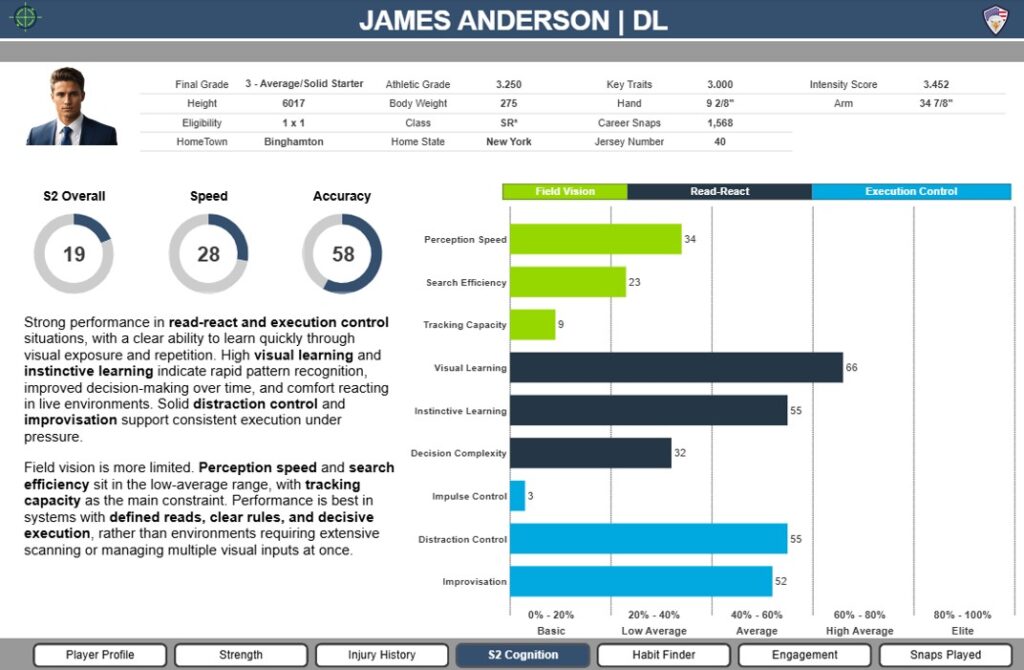
From there, everything was mapped and displayed inside their personalized Recon dashboards. Each player’s cognitive profile became part of a larger picture—layered alongside their on-field performance, weight room progress, academic data, and internal evaluations. Staff could now view and interact with every dimension of a player’s identity, strengths, and development trends from one place.
The result was a seamless, always-updated, mobile-friendly interface that made powerful data actually usable. What used to be a stack of PDFs became a live, working tool that the staff could apply to decision-making daily.
Advantage
Now the team isn’t just collecting elite-level assessments. They’re using them. Coaches can identify patterns between mental traits and on-field outcomes. Player development staff can spot trends across successful position groups. Recruiting conversations are more informed because the staff knows not just who the player is physically, but how he thinks, trains, and grows.
Everything lives inside one private system. No more PDFs buried in folders. No more wondering how a player’s processing speed might affect his route timing or how focus and discipline scores align with injury recovery. It’s all there, connected, and in plain sight.
And because it’s secure and internal, teams get the full value of those cognitive investments without ever compromising confidentiality.
What’s Now Possible
The coaching staff can now track how cognitive strengths map to real success over time. They can spot red flags before they show up in behavior. They can tailor communication and training based on how a player is wired to think and learn. Evaluations become more accurate. Development becomes more personal. Recruiting becomes more precise.
Most importantly, the organization now uses every piece of insight it collects. No more wasted assessments. No more hidden data. Just a clear, connected system that puts powerful information to work—securely, efficiently, and in real time.