
Context That Changes the Conversation.
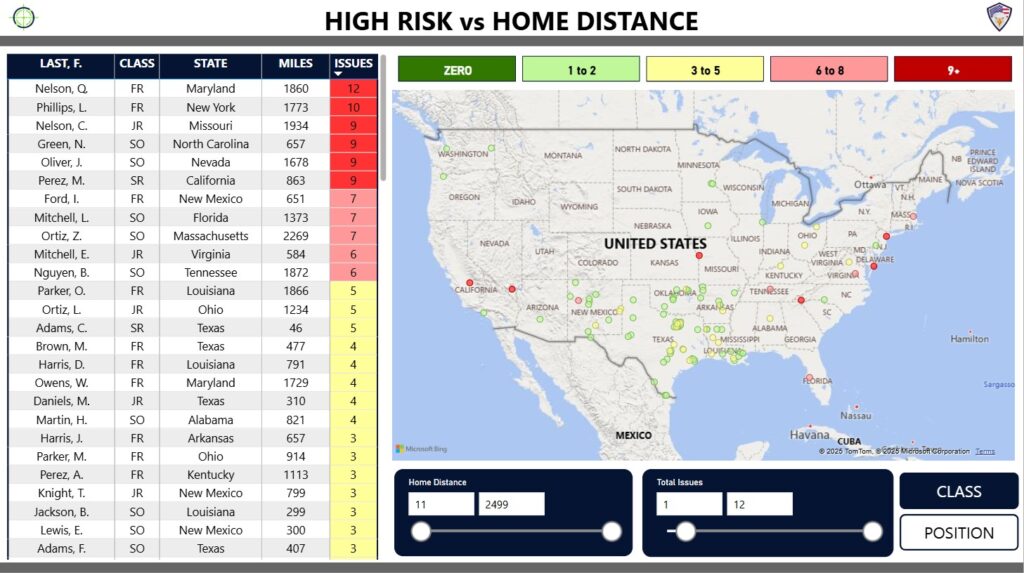
A spatial risk analysis tool that overlays negative events or issues with distance from home, helping staff identify patterns that are easy to miss in traditional reports.
Programs track issues—missed lifts, academic flags, availability concerns, behavioral notes—but those events are usually viewed in isolation. What’s often missing is context. Without it, staff are left reacting instead of understanding.
High-Risk Athletes adds that missing layer.
This product correlates the frequency and type of issues a player experiences with how far they are from home, allowing staff to explore whether geography, transition stress, or distance-related factors may be contributing. Athletes are visualized geographically, and any issue type can be overlaid and color-coded on top of that map in real time.
This isn’t about labeling athletes—it’s about seeing the full picture.
Features & Advantages
| Feature | Real-World Impact |
|---|---|
| Issue aggregation | Combine all tracked issues or negative events in one view |
| Distance-from-home analysis | Add geographic context to athlete risk conversations |
| Interactive mapping | See where athletes live and how risk distributes spatially |
| Issue overlays | Layer any issue type on the map with custom color coding |
| Dynamic filtering | Adjust by issue type, severity, timeframe, or roster group |
| Visual pattern detection | Identify clusters and trends that tables can’t reveal |
| Exportable views | Share insights with leadership or support staff when needed |
Why It Matters
Some risk factors don’t show up in spreadsheets.
By visualizing where athletes come from alongside what they’re experiencing, staff can ask better questions earlier. Are certain players navigating more off-field stress? Are distance and transition playing a role? Is additional support needed for specific groups?
This tool helps teams move from reactive responses to informed, proactive support—without assumptions or guesswork.
Built for Collaboration, Not Conclusions
High-Risk Athletes is designed to support conversations across performance, nutrition, academics, and player development. It provides context, not verdicts—giving staff a shared view to align around before issues escalate.
Better context.
Earlier insight.
Smarter intervention.